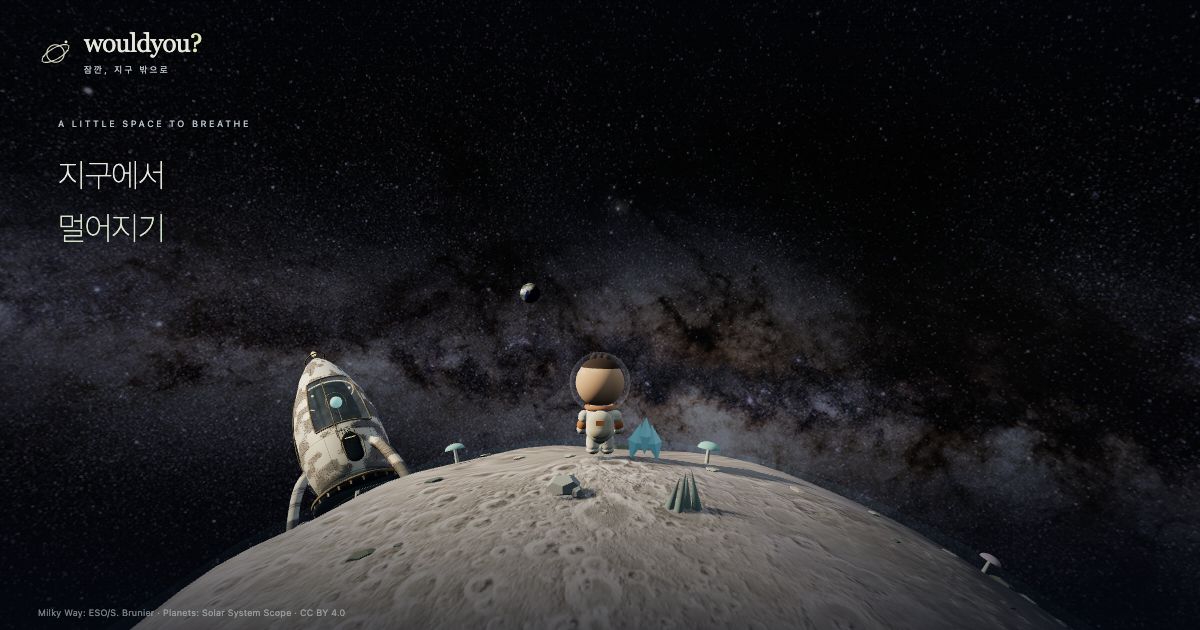
An online star map.A little time at the telescope.
wouldyou? is a free 3D social space where you can walk a tiny planet and rest with other travelers. Explore stars around the Sun on an online star map, then try a virtual telescope. The experience uses credited NASA and ESA images and catalog data. No installation or signup is required.
An actual wouldyou? scene · Milky Way: ESO/S. Brunier · Planet maps: Solar System Scope · CC BY 4.0
Open a map of 100,000 stars around the Sun
Enter the space and choose “Open star map” in the top toolbar. This opens “Stars around the Sun.” Drag to change direction. Use the wheel, a two-finger pinch, or the zoom buttons to change your view.
Look at the distribution of stars. The map uses actual position and distance records from HYG v4.1: 100,000 stars in normal graphics and 32,000 in light graphics. Their locations come from a catalog. Point size and brightness are adjusted for the screen.
Return to the solar-system origin. “Sun · You are here” marks the origin of our solar system. Select it to return to the close view of the little planet. You can also choose Earth or another observation target from the sky menu.
This is a frozen visualization of J2000.0 catalog records. It does not calculate current precision star positions or control a physical telescope.
Observe Earth, planets and stars through a virtual telescope
Walk to the telescope on the right of the whiteboard and select it. Pan with the direction buttons or by dragging inside the circular eyepiece, then change magnification. The observation point stays fixed. The ◎ button frames the whole body again.
Earth’s surface
Choose Earth and zoom in to load the visible region from the EOxCloudless 2016 Sentinel-2 composite, with an approximately 10m source resolution. If the first connection fails, the view uses NASA/USGS 1999 Landsat imagery at approximately 31m. The on-screen credit identifies the active source.
The Sun and planets
Select Earth, the Sun, Mars, Saturn, Neptune or a neighboring fictional world. Approximate solar-system directions use JPL orbital data. Rendered distances and sizes are adapted to keep the scene usable for walking and viewing.
Four real catalog stars
Choose Sirius, Vega, Betelgeuse or Polaris. Their directions use J2000 coordinates from the BSC5P catalog hosted by NASA HEASARC. They remain unresolved points when magnified; the telescope does not show photographs of their surfaces.
Rest after observing
Return to “My planet” to spend time with other travelers, or save the scene with the top camera button. Choose light graphics in Settings if the view is slow. The speaker button controls music and ambient sound.
The Milky Way sky panorama uses ESO/S. Brunier’s 6,000×3,000px photograph. The large galaxy scene uses the 6,637×3,787px Hubble photograph of NGC 1300, credited to NASA, ESA, and The Hubble Heritage Team (STScI/AURA). NGC 1300 is another spiral galaxy, used here to illustrate our galaxy. It is not a photograph taken from outside the Milky Way.
Earth imagery is a historical satellite composite. It does not show live weather, Google Maps, Street View or current buildings. Space distances, sizes and distant-galaxy placement include visual compression and artistic choices. This experience does not provide field-observation directions, a precision compass or navigation ephemerides.
100,000 Stars is an interactive stellar-neighborhood visualization released by Google Data Arts Team in 2012. Its official description distinguishes catalog star locations from an artist’s galaxy view. There is also an official making-of article.
wouldyou? is a separate social space made by HongSimdang. It combines a HYG v4.1 star map with walking on little planets, observing Earth through a virtual telescope, and resting with other travelers. Use the official link above to find Google’s original experiment, or enter wouldyou? to try its planets and telescope. wouldyou? is independently operated and is not affiliated with or endorsed by NASA or Google.
Questions about the space observation experience
Does the star map really contain 100,000 stars?
Normal graphics show 100,000 selected HYG v4.1 records; light graphics show 32,000. Uncertain distance records are excluded. This is a frozen J2000.0 catalog visualization, not current precision astrometry. Point size and brightness are adjusted for display.
How do I open the star map and telescope?
Choose “Open star map” in the top toolbar to view stars around the Sun. The telescope stands to the right of the whiteboard on the little planet. Walk close, select it, choose a target and use the direction, drag and zoom controls.
Is this a NASA site or part of Google’s 100,000 Stars?
No. wouldyou? is an independent social space operated by HongSimdang. It credits public NASA, ESA and other sources. Using those sources does not imply operation, affiliation or endorsement by NASA or Google. Google’s 100,000 Stars is a separate official experience.
Can I see star surfaces or live images of Earth?
Stars are shown as unresolved points, without photographs of their surfaces. Earth uses the EOxCloudless 2016 Sentinel-2 composite at approximately 10m, with NASA/USGS 1999 Landsat imagery at approximately 31m after an initial connection failure. These are historical images, not live satellite video or street maps.
Which objects can I select?
The telescope offers Earth, the Sun, Mars, Saturn, Neptune, neighboring fictional worlds, Sirius, Vega, Betelgeuse and Polaris. The 100,000-star map is a separate view of stellar distribution; it does not provide surface views or detailed observation of every catalog star.
Can I use it to plan field observations or measure precise distances?
The experience combines a frozen star catalog, approximate solar-system data and artistic scenes. Rendered distances and sizes are compressed or adapted. It does not provide local observing directions, current weather, a precision compass or navigation ephemerides.
Is it free, and do I need an account or installation?
The star map and telescope are free, with no installation or signup. The 3D space requires a browser with JavaScript and WebGL 2. Performance depends on your device. This guide can be read without JavaScript.
Is the galaxy image a photograph of the Milky Way from outside?
The large galaxy scene uses a Hubble photograph of another spiral galaxy, NGC 1300, to illustrate our galaxy. It is not an external photograph of the Milky Way. The sky’s Milky Way panorama is credited to ESO/S. Brunier.